How to Build a Retail & E-Commerce Talent Pipeline Before You Need It
Retail and e-commerce hiring is changing faster than many workforce plans can keep up with. Discover why reactive recruitment fails and how to build a high-conviction passive talent pipeline for critical commercial, technology, and operations roles.
Why talent pipelines matter more than ever in 2026.
The sector is no longer hiring only for traditional retail operations, merchandising, sales, and category management. E-commerce and quick-commerce companies increasingly need specialists in technology, AI, analytics, supply chain, fulfilment, product, marketplace operations, customer experience, and commercial leadership.
That creates a familiar problem for HR and business leaders: by the time a critical role opens, the best candidates may already be working for someone else. The answer is not to recruit faster after a vacancy appears. It is to build a retail and e-commerce talent pipeline before the business needs it.
+35%
Growth in e-commerce and quick-commerce talent demand from 2023 to 2025 (CIEL HR).
>3x
Expansion in technology and engineering demand for fulfilment and AI customer experiences.
21%
YoY white-collar hiring growth in quick-commerce as the market pivots toward profitability.
This creates a paradox for employers: companies are hiring more deliberately and selectively, but the roles they do hire for are far more specialised. A passive talent pipeline turns that challenge into a competitive advantage.
What is a talent pipeline? (It's not a database of resumes).
A talent pipeline is a structured pool of potential candidates who have already been identified, mapped, assessed, and engaged for current or future hiring needs. It is fundamentally different from maintaining a stagnant resume database.
The goal is to move from reactive recruitment to proactive talent intelligence.
A high-functioning talent pipeline answers critical commercial questions well before day zero:
Target Market Depth: Who are the strongest operators in our competitive ecosystem?
Employer Footprint: Where do they currently work and what scale have they managed?
Verified Capability: What verifiable technical, P&L, or domain skills do they possess?
Role Fit: What mandate could they realistically step into?
Compensation Realities: What is their realistic compensation expectation and equity appetite?
Motivation & Timing: How scarce is their profile, are they open to moving, and when?
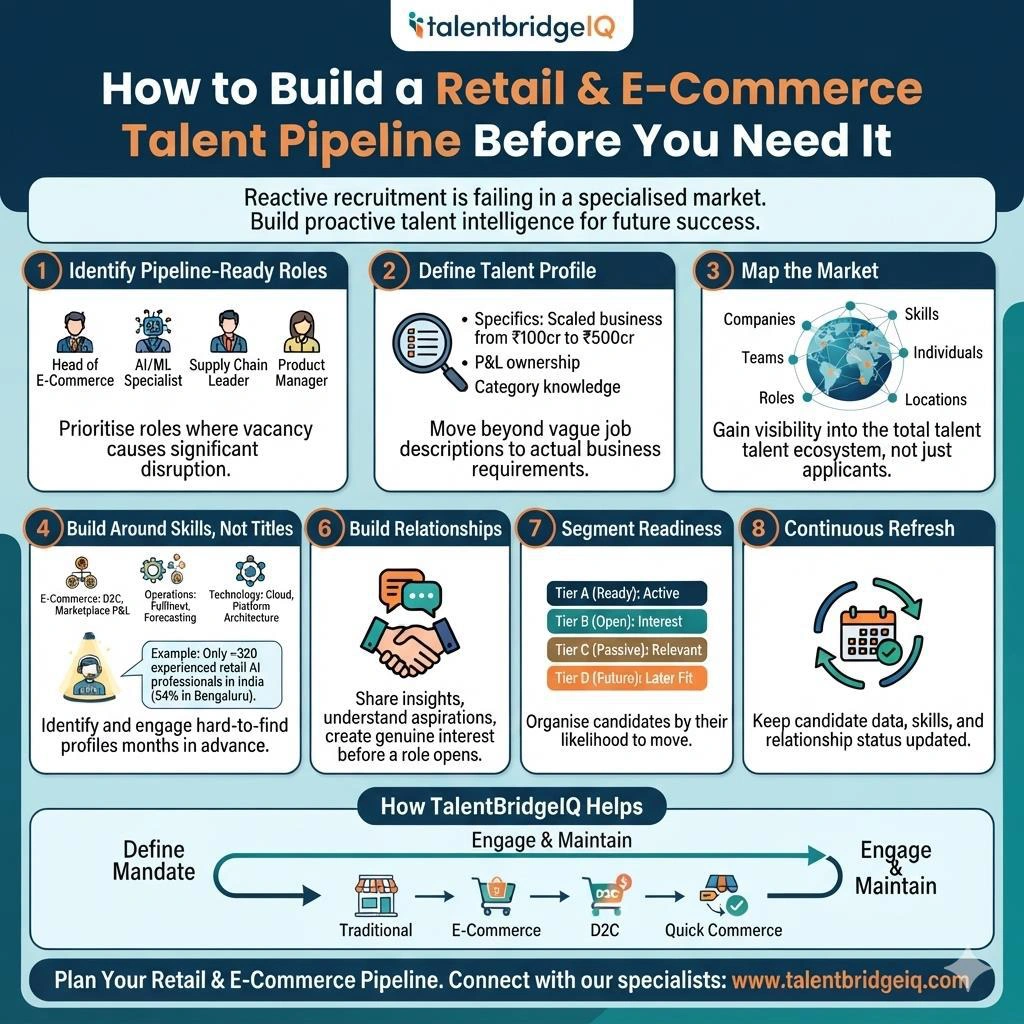
The 9-step framework to build a proactive retail talent pipeline.
Building a dependable talent intelligence engine requires systematic operational discipline across nine distinct phases:
Step 1: Identify Priority Pipeline-Ready Roles
Not every position needs a permanent pipeline. Prioritise positions where an unexpected vacancy creates acute commercial or operational disruption: Head of E-Commerce, Category Heads, Supply Chain & Fulfilment Leaders, D2C Growth Leads, Marketplace Managers, and AI/ML Specialists. Ask: "Which roles would take too long to replace if the incumbent left tomorrow?"
Step 2: Define the Mandate Profile Before Searching
Move beyond vague job descriptions. Instead of "experienced e-commerce leader", specify: scaled an online business from ₹100Cr to ₹500Cr, owned an omnichannel P&L, navigated marketplace logistics, and managed cross-functional teams in your specific category.
Step 3: Map the Market Before You Need Candidates
Map the market across Companies → Teams → Roles → Individuals → Skills → Locations. In India, retail talent is heavily distributed across traditional retailers, D2C startups, and over 180 retail GCCs employing 272,300+ professionals (projected to reach 41,000 tech roles by 2028).
Step 4: Build Talent Pools Around Skills, Not Just Titles
Job titles vary widely across companies ("Marketplace Lead" vs "E-Commerce Director"). Organize talent around skill clusters: E-Commerce (P&L, conversion, marketplaces), Commercial (merchandising, vendor terms), Operations (fulfilment, demand forecasting), and Tech/Data (AI/ML, recommendation engines).
Step 5: Prioritise Scarce Talent Early
Specialised talent pools require significant lead time. For example, retail GCC AI penetration has doubled to 4.8%, yet India has only ~320 senior AI professionals with 8+ years experience in retail GCCs (54% in Bengaluru). Scarce talent must be mapped months in advance.
Step 6: Create Relationships, Not Just Candidate Records
A pipeline becomes valuable when candidates know and respect your brand. Engage through industry insights, career aspiration discussions, and private networking rather than unsolicited job pitches.
Step 7: Segment Candidates by Readiness
Segment talent into actionable readiness tiers: Tier A (Ready) — actively exploring; Tier B (Open) — receptive to the right opportunity; Tier C (Passive) — high caliber, longer-term relevance; Tier D (Future) — emerging profiles to track.
Step 8: Continuously Refresh the Pipeline
A talent pipeline is a living intelligence system. Regularly update employer movements, skill growth, compensation expectations, availability, and relationship status across priority talent pools.
Step 9: Use Hiring Data to Drive Workforce Decisions
Evaluate talent supply data to make strategic adjustments. If senior supply chain leaders in Bengaluru are scarce or compensation is inflated, consider expanding into Hyderabad or Pune, redesigning role scopes, or investing in internal development.
How TalentBridgeIQ builds high-conviction retail talent pipelines.
TalentBridgeIQ approaches talent pipelines as a market-mapping and relationship discipline, backed by DashMindsIQ's engineering and data rigor. We help retail and consumer brands navigate the full pipeline lifecycle:
A practical scenario: Scaling from ₹100Cr to ₹500Cr.
Imagine a fast-growing D2C consumer brand planning to expand into three new categories over the next 12 months. The leadership knows it will need two Category Heads, one Head of Marketplace, one Supply Chain Director, and one Product Leader.
Instead of waiting for headcount sign-off and starting from a cold search, the company initiates market mapping six months early. When the mandate goes live, hiring managers don't start from zero — they already know who is qualified, what compensation package is needed, who is ready to move, and how to close them.
The bottom line for retail and e-commerce leaders in 2026.
Retail hiring in 2026 is capability-led. Emerging capabilities in quick-commerce and AI are creating structural shortages that job boards cannot solve. The companies that consistently hire top talent will be those that build relationships before vacancies arise.
A structured talent pipeline gives hiring teams what traditional recruitment never can: time, market intelligence, and choice.
T
TalentBridgeIQ Editorial Team
Retail & E-Commerce Workforce Practice
Planning Your Retail & E-Commerce Talent Pipeline?
Talk with TalentBridgeIQ's specialized retail recruitment advisors to map your critical talent pools and build a proactive talent pipeline aligned with your business expansion.