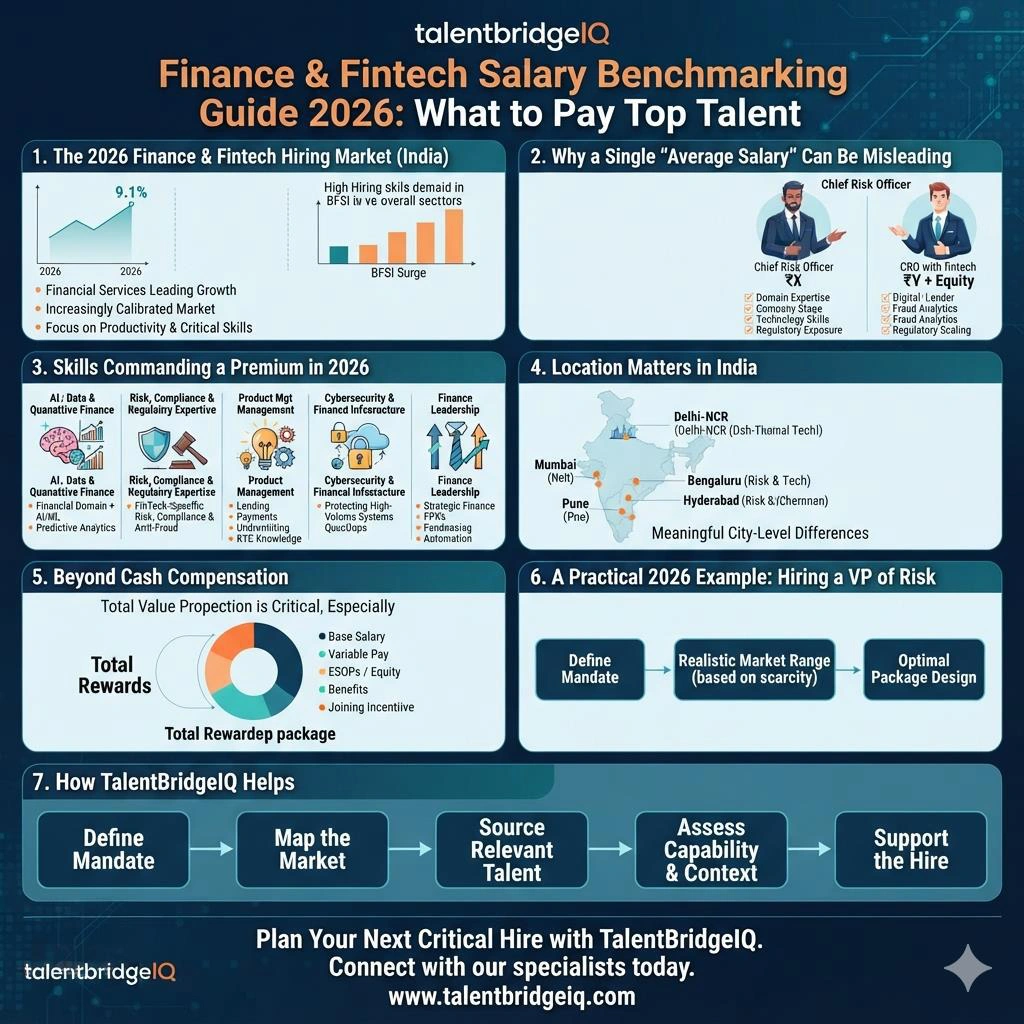
Finance & Fintech Salary Benchmarking Guide 2026: What to Pay Top Talent
Compensation in finance and fintech is increasingly skills-led rather than title-led. Explore realistic market benchmarks across AI, credit risk, regulatory compliance, product, and financial leadership in India.
The 2026 finance & fintech hiring landscape in India.
India's overall compensation market remains stable, with Deloitte's 2026 India Talent Outlook projecting average salary increases of 9.1% (up from 9.0% in 2025). Financial services and fintech are among the sectors maintaining higher salary growth as organizations balance business expansion with strict cost discipline, productivity targets, and risk management.
9.1%
Projected average salary increase across India, with financial services leading gains (Deloitte).
+25%
YoY surge in AI/ML hiring in BFSI & fintech for fraud detection and risk modeling (Naukri).
₹41L
Median total compensation benchmark for Senior Software Engineers at Tier-1 Indian fintechs.
Reports from PeopleLogic highlight BFSI postings as the primary growth driver month-over-month. However, employers are becoming far more selective about which capabilities justify a premium.
Why a single "average salary" can produce poor hiring decisions.
Salary benchmarking often begins with a simplistic question: "What is the average salary for this title?"
Consider two Chief Risk Officers: one has spent 20 years in traditional branch banking risk management. The other has built real-time underwriting algorithms for a digital lending platform, managed automated fraud analytics, and navigated complex RBI regulatory scaling. Their titles are identical, but their market valuation and operational capability are worlds apart.
The objective is not to find one "correct" number. It is to establish a competitive compensation range for the specific capability your business needs.
Defensible compensation benchmarking must account for:
Domain & Functional Scope: Payments vs. lending vs. wealthtech vs. core banking.
Regulatory Exposure: Direct RBI interface, NBFC compliance, and statutory audits.
Technology Exposure: Microservices, automated underwriting, AI/ML models, and APIs.
Stage of Company: Seed vs. Series B vs. pre-IPO vs. regulated corporate entity.
Geographic Location & Talent Scarcity: Metro availability vs. relocation premiums.
2026 finance & fintech salary benchmarks: What to expect.
Fintech salary structures cannot simply borrow from conventional banking or generic IT pay bands. Market placement data and compensation studies (Michael Page India 2026) illustrate key benchmarks:
Senior Fintech Engineers & Architects
₹35–65 Lakh+ total compensation for Tier-1 payments infrastructure, distributed ledger systems, and low-latency transaction engines.
Risk, Credit & Underwriting Leaders
₹45–95 Lakh+ for leaders combining algorithmic credit modeling, collections strategy, and portfolio risk management.
Fintech Product Managers (Lending/Payments)
₹30–75 Lakh for product leaders with deep knowledge of KYC, payment rails, API monetization, and regulatory constraints.
Strategic Finance & CFO Leadership
₹70L–₹2.2Cr+ for CFOs, VP FP&A, and controllers driving unit economics, debt syndication, and investor governance.
The five fintech skills commanding the highest premiums.
1. AI, Data & Quantitative Finance: High demand for professionals who bridge financial domain acumen with automated credit scoring, fraud detection, and predictive modeling.
2. Risk, Compliance & Regulatory Strategy: Growth does not eliminate regulation. Experience scaling regulated NBFCs, payment aggregators, and digital lending guidelines commands a premium.
3. Specialized Product Architecture: Product leads who understand unit economics, API integrations, and checkout conversion rather than just front-end UI.
Bengaluru: Deepest concentration of fintech engineering, product, AI/ML, and VC-backed venture leadership.
Delhi-NCR: Strong for corporate finance, digital lenders, policy interface, and commercial leadership.
Hyderabad, Pune, Chennai: Fast-growing centers for core banking operations, risk analytics, and global financial GCCs.
Don't benchmark cash compensation alone: Structure total rewards.
Fintech compensation requires an attractive, balanced total value proposition:
Base Salary + Variable Pay + ESOPs/Equity + Benefits + Joining/Retention Incentives = Total Rewards
A candidate transitioning from an established bank to a growth-stage fintech may accept lower fixed cash if the equity upside and vesting structure are credible. Conversely, seasoned leaders in volatile markets prioritize guaranteed fixed pay and clear performance milestones.
A practical 2026 example: Hiring a VP of Risk.
A fintech company budgets ₹70 Lakh for a VP of Risk based on what it paid two years ago. The role requires digital lending experience, automated underwriting, fraud analytics, and direct RBI interface experience.
Market intelligence shows that candidates possessing this rare intersection of skills are commanding ₹85–100 Lakh. Instead of losing months on rejected offers, the company can structure a package of ₹75 Lakh fixed + ₹20 Lakh performance variable + meaningful equity, securing top-tier leadership without breaking internal pay parity.
How TalentBridgeIQ helps finance & fintech companies hire.
TalentBridgeIQ combines specialized finance recruiters with live talent intelligence to turn recruitment into a predictable, data-driven process:
TalentBridgeIQ Editorial Team
Finance & Fintech Compensation Advisory Practice
Planning a Finance or Fintech Hire?
Talk with TalentBridgeIQ's specialized finance and fintech recruitment advisors to benchmark salaries, map candidate availability, and structure winning compensation packages.